Rechercher dans Standen & Landen

Showing posts with label geschiedenis van het publiekrecht. Show all posts

24 September 2020

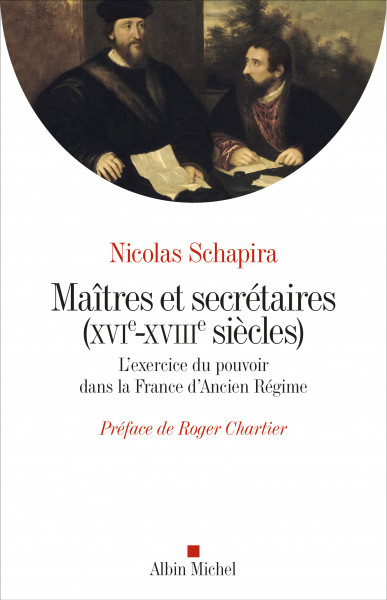
BOEK/OUVRAGE: Nicolas SCHAPIRA, Maîtres et secrétaires (XVIè - XVIIIè siècles). L'exercice du pouvoir dans la France d'Ancien Régime (Paris: Albin Michel, 2020), 336 p. ISBN 978-2-2264-5305-1, € 24

(bron/source afbeelding/image: univ-droit)

Samenvatting/résumé:
Secrétaire, secrétariat : une figure aujourd’hui omniprésente, une présence qui va de soi. Il fut un temps où le secrétaire était un domestique, un intime, gardien des secrets et des affaires privées de son maître. L’enquête de Nicolas Schapira met en lumière l’apparition de ce couple, où l’un décide tandis que l’autre conseille, écrit, et tient mémoire. C’est entre Renaissance et âge des Lumières, au moment où le papier devient le support de toute décision, que paraît ce personnage nouveau, pouvant être simple scribe comme conseiller des princes, reconnu pour son expertise. Quelle que soit sa condition, le secrétaire est une silhouette de l’ombre : des traités sont écrits pour louer son action et ses compétences, mais les contemporains dénoncent son influence excessive et son ubiquité. Associant les méthodes de l’histoire et des sciences sociales, ce livre raconte l’ascension d’un groupe qui ne s’identifiait ni à un métier ni à un statut, mais dont le pouvoir s’accrut à mesure que l’État se construisait sous l’Ancien Régime et qu’il pénétrait progressivement toutes les strates de l’administration, jusqu’à nos jours.

 Over de auteur/sur l'auteur:

Agrégé et docteur en histoire, Nicolas Schapira est professeur d’histoire moderne à l’Université Paris Ouest Nanterre. Il est l’auteur, notamment, de Un professionnel des lettres au XVIIe siècle. Valentin Conrart : une histoire sociale, Champ Vallon, 2003 ; et (en collaboration) de Histoire Littérature Témoignage. Écrire les malheurs du temps, Gallimard, 2009

(bron/source: univ-droit)

17 May 2019

BOOK: Michel HÉBERT, La voix du peuple. Une histoire des assemblées au moyen Âge (Paris: PUF, 2019), 308 p. ISBN 978-2-13-073611-0, € 22

(image source: PUF)

Book abstract:
Le peuple a bon dos. Parler en son nom est un idéal politique aussi répandu que galvaudé. C'est le fondement même de la démocratie occidentale, mais aussi la source de tous les populismes. Porter la parole du peuple, c'est se l'approprier et, dans le champ du politique, le faire exister. Le problème non encore résolu de la figuration du peuple est d'abord et avant tout un problème de représentation, puisque ce peuple ne peut exister comme sujet politique qu'à travers ce processus. Aux derniers siècles du Moyen Âge, l'Europe occidentale chrétienne voit le développement d'assemblées territoriales qui, sous diverses dénominations (parlements, états généraux, cortes ou diètes), sont le lieu d'expérimentation d'une représentation politique constitutive de l'Etat moderne, lointain ancêtre des régimes démocratiques contemporains. Cette représentation met en place des instances médiatrices entre des sociétés politiques en pleine émergence et des princes dont la souveraineté n'a encore rien d'absolu. Le présent ouvrage s'intéresse à la fois aux idées des théologiens, des philosophes ou des juristes, et aux pratiques de ces assemblées qui investissent les peuples d'une autorité nouvelle.
On the author:
Professeur émérite à l'université du Québec à Montréal, Michel Hébert est membre de l'Académie des arts, lettres et sciences humaines de la Société royale du Canada. Il est notamment l'auteur de Parlementer. Assemblées représentatives et échange politique en Europe occidentale à la fin du Moyen Âge (De Boccard, 2014), premier prix Gobert de l'Académie des inscriptions et belles-lettres. 
See more with the publisher's website.
(source: ESCLH Blog)

16 May 2019

CALL FOR PAPERS: Printing and disseminating the Law in the Habsburg Netherlands, the Dutch Republic and the Prince-Bishopric of Liege in the early modern period (16th-18th century) (Liège: 5-6 DEC 2019); DEADLINE 30 JUNE 2019


(image source: Renaud Adam/ULiège)

Presentation

Nowadays, the law is the sparkling star of a complex normative galaxy. The purpose of the law is to provide a reference point for a community while it manifests the sovereign’s will. If this situation does not entirely reflect the status of the law in the early modern period, it must be recognized that early modern lawyers like Jean Bodin did not hesitate to place the legislative power at the forefront of princely prerogative. The law is therefore a legal instrument in the service of the government of a given territory, but it is also a means of communication between rulers and subjects.

The drafting and publication of the law are two sides of the same coin. The early modern period paved the way for the printing of legislative acts and, consequently, for the wide dissemination of promulgated texts. However, there is no evidence of the vanishing of handwritten texts. In addition to the printing of new laws, in the form of placards and ordinances, we should also recognise the importance attached to more substantial customs.  Indeed, princes and sovereigns were keen to ensure that customs were repeatedly renewed and updated to reinforce the legislative corpus. With each successive round of amplifications the authorities - central, provincial or local - turned again to the printing presses.

This international conference aims to question the topic of the printing and distribution of laws in the early modern period by comparing the Habsburg Netherlands, the Dutch Republic and the Prince-Bishopric of Liege. The authorities in all three territories made extensive use of printing to ensure the rapid mass dissemination of official documents - including legislation. At the local level, for example, the arrival of the first printers in several cities is directly linked to the willingness of the municipal authorities to have a press at their disposal. The advent of the privilege system also allowed some printers to secure monopolies that they tried to transform into dynastic monopolies in order to secure substantial revenues.

While several investigations have been dedicated to this topic, it must be noted that this phenomenon has not yet received all the attention it deserves and that many issues still need to be addressed; we have thus far had an incomplete and unrepresentative perspective on the printing of laws in the early modern period.


The organizers welcome contributions on any facet of this subject. Possible themes include:

- which formats are used for printing laws? Does the layout of legislative texts meet a particular standard or not?

- Relationship between printers and authorities: What links do the authorities - central, provincial or municipal - have with printers? Can we establish an accurate profile of printers active in the field of ordinance printing? What status did these printers have in urban society? What role did these documents play in their output? What were the advantages of being an official printer? By what means was legislative production supervised and monitored by the various authorities?

- The effects of print on law-making: did the printing of laws have an influence on the decision-making process? Are explicit references to the printing of laws included in the promulgated acts themselves?

- The dissemination of the law: is it possible to trace the distribution channels? What are the roles of the different actors in the book trade? Is it possible to know the places and times of publication of printed texts?


*
*  *


Please submit a proposal (300 words maximum) and a CV (maximum 1 page) by 30 June 2019 to Renaud Adam (renaud.adam@uliege.be) and Nicolas Simon (n.simon@uclouvain.be). Participants will be notified by the end of August. The conference proceedings will be published in English.

Organizing Committee: Renaud Adam (ULiège), Annick Delfosse (ULiège), Julien Régibeau (ULiège), Nicolas Simon (UCL/USL-B), Arthur der Weduwen (University of St Andrews).

Scientific Committee: Renaud Adam (ULiège), Wim Decock (KUL, ULiège), Annick Delfosse (ULiège), Frederik Dhondt (VUB/UAntwerpen), Nicolas Simon (FNRS-UCL/USL-B), Andrew Pettegree (University of St Andrews), Arthur der Weduwen (University of St Andrews).

(source: ESCLH Blog)

15 May 2019

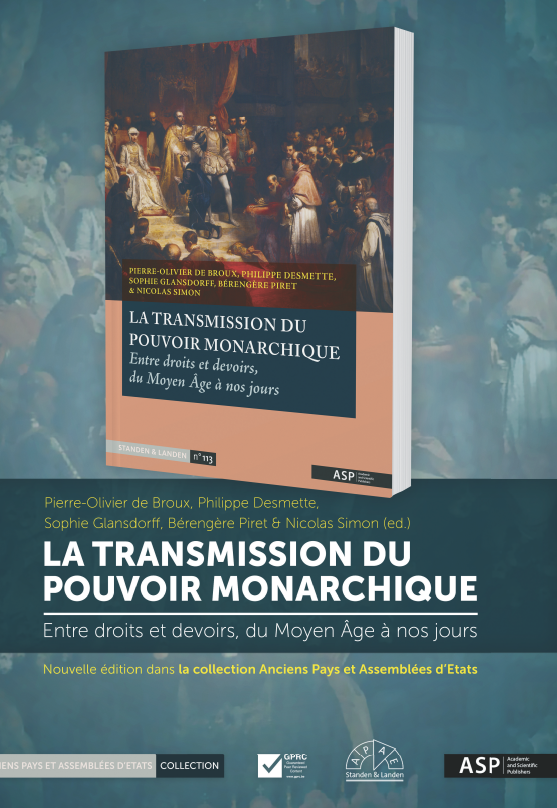
RAPPEL/HERINNERING: Présentation d'ouvrage/Boekvoorstelling vol. 113 Anciens Pays et Assemblées d'États/Standen en Landen: La transmission du pouvoir monarchique (eds. Pierre-Olivier DE BROUX et al.) (Bruxelles/Brussel: Coudenberg, 24 MAI/MEI 2019)

(bron afbeelding/source d'image: ASP)

Op vrijdag 24 mei om 17:00 stelt Standen en Landen trots volume 113 in de reeks voor. La transmission du pouvoir monarchique, entre droits et devoirs. Du moyen Âge à nos jours bundelt bijdragen van Jean-Marie Cauchies, Gustaaf Janssens, Frédérique Lachaud, Sophie Glansdorff, Klaas Van Gelder, Frederik Dhondt, Pierre-Olivier De Broux, Vincent Dujardin en Matthias El Berhoumi. De voorstelling wordt opgeluisterd door een lezing van Prof. Gilles Lecuppre (UCLouvain/Paris Ouest Nanterre La Défense) en gaat gepaard met een receptie en bezoek aan de kelders van het voormalige paleis van onze landsheren.

Standen en Landen a l'honneur de présenté avec fierté le volume 113 de sa collection historique, le vendredi 24 mai à 17:00. La transmission du pouvoir monarchique, entre droits et devoirs. Du moyen Âge à nos jours réunit les contributions de  Jean-Marie Cauchies, Gustaaf Janssens, Frédérique Lachaud, Sophie Glansdorff, Klaas Van Gelder, Frederik Dhondt, Pierre-Olivier De Broux, Vincent Dujardin et Matthias El Berhoumi.  La présentation est accompagnée d'une conférence du professeur Gilles Lecuppre (UCLouvain/Paris Ouest Nanterre La Défense) et d'un verre d'amitié, couplé d'une visite des caves de l'ancien palais des souverains des Pays-Bas.

Inschrijven/inscriptions: info@aspeditions.be .

2 May 2019

OPEN ACCESS: Luc DHONDT, Verlichte monarchie, Ancien Régime en Revolutie. Een institutionele en historische procesanalyse van politiek, instellingen en ideologie in de Habsburgse, de Nederlandse en de Vlaamse politieke ruimte (1700/1755-1790) [Studia; 89] (Brussel: Algemeen Rijksarchief, 2002-2007), 2990 p.

(bron/source afbeelding/image: Wikimedia Commons)

Het Algemeen Rijksarchief verspreidt via zijn webshop in open access de gepubliceerde versie van de doctoraatsverhandeling van wijlen dr. Luc Dhondt (UGent, Nieuwe Geschiedenis), Verlichte monarchie, Ancien Régime en Revolutie. Een institutionele en historische procesanalyse van politiek, instellingen en ideologie in de Habsburgse, de Nederlandse en de Vlaamse politieke ruimte (1700/1755-1790). Het proefschrift (16 delen, 9 volumes) werd in 1993 verdedigd onder promotorschap van wijlen Prof. dr. Michel Baelde. De publicatie van een deels herwerkte versie geschiedde tussen 2002 en 2007, in de reeks Studia van het Algemeen Rijksarchief.

Deze studie in acht volumes en 2990 pagina's behandelt op extensieve wijze de opstand tegen Jozef II in het graafschap Vlaanderen. Ze is gebaseerd op twintig jaar archiefonderzoek in België en Oostenrijk.

Les Archives de l'Etat en Belgique viennent de mettre à disposition en accès libre la version publiée de la thèse de doctorat soutenue par feu le dr. Luc Dhondt (Université de Gand, histoire moderne) en 1993 (16 parties, 9 volumes) sous la direction de feu le professeur Michel Baelde, Verlichte monarchie, Ancien Régime en Revolutie. Een institutionele en historische procesanalyse van politiek, instellingen en ideologie in de Habsburgse, de Nederlandse en de Vlaamse politieke ruimte (1700/1755-1790). La publication d'une version partiellement révisée a eu lieu entre 2002 et 2007, dans la collection Studia des Archives de l'État.

L'étude comprend huit volumes et 2990 pages. Elle traite de façon exhaustive la révolte contre Joseph II dans le comté de Flandre. Elle est basée sur un travail d'archives de plus de vingt ans en Belgique et en Autriche.

Inhoudstafel/table des matières:
Woord vooraf (Prof. em. dr. Herman Balthazar) - Ten Geleide
Deel I: Itinerarium, benadering en analytische conclusies
Hoofdstuk 1: Voorwerp en uitgangspunten van dit onderzoek
Hoofdstuk 2: Sociologische benaderingen van een observatieveld en meer bepaald, het politieke
Hoofdstuk 3: De politiek-institutionele geschiedschrijving en haar omgeving
Hoofdstuk 4: De historische staatstudie en de politiek-institutionele geschiedschrijving
Hoofdstuk 5: De studie van de Revolutie en de historiografie van de Franse en Brabantse omwentelingen van 1789
Hoofdstuk 6: Algemene benaderingen in ons onderzoek
Hoofdstuk 7: Aflijning, specifieke benaderingen en bronnen

Deel II: Het Habsburgs hervormingsstreven
Inleiding: De aandacht voor Jozef II in het kader van het politieke proces in de Nederlanden
Hoofdstuk 1: De wortels van het jozefijnse hervormingsstreven, macht en onmacht van Habsburg
Hoofdstuk 2: Van kroonprins tot verlicht despoot
Hoofdstuk 3: De hervormingen van Jozef II
Hoofdstuk 4: De weg naar de mislukking en het dramatische einde

Deel III: Het Ancien Régime in Vlaanderen
Hoofdstuk 1: De centrale staat
Hoofdstuk 2: De institutionele orde in Vlaanderen
Hoofdstuk 3 'In Margine': codes, mutaties en spanningen in de oude maatschappij in Vlaanderen

Deel IV: De hervormingsbeweging in de Zuidelijke Nederlanden
Hoofdstuk 1: De kennismaking (1780-81)
Hoofdstuk 2: De hervormingen

Deel V: De weerstand van de oude orde
Hoofdstuk 1: De lokale machtigen en de constitutionalistische reactie tussen theresiaans compromis en jozefijnse hervormingsbeweging
Hoofdstuk 2: De constitutionele reactie op de vroege jozefijnse hervormingen
Hoofdstuk 3: 1787: de onmogelijke revolutie

Deel VI: De onherstelbare oude orde
Hoofdstuk 1: Het uitgangspunt voor een nieuwe revolutie: de verklaring van 21 september 1787 en de nieuwe gematigde, constitutionele monarchie
Hoofdstuk 2: De machtsgreep van de constitutionelen
Hoofdstuk 3: Het herstel van de vorstelijke autoriteit
Hoofdstuk 4: Het failliet der strategieën: van impasse tot revolutie (1787-1789)

Deel VII: De Revolutie

Hoofdstuk 1: De institutionalisering van de revolutie
Hoofdstuk 2: De crisis van de revolutie
Epiloog: De ondergang van het revolutionair regime

Deel VIII: Bibliografie en bijlagen
Het werk kan in de gepubliceerde versie (1,1 GB) hier worden gedownload (DOI 10.17605/OSF.IO/3PVKW).
De gedrukte versie kost € 114 en kan worden besteld op de webshop van het Algemeen Rijksarchief.

L'ouvrage peut être téléchargé (1,1 Go) ici (DOI 10.17605/OSF.IO/3PVKW).
La version imprimée peut être commandée auprès des Archives de l'Etat (€ 114), sur le webshop.


29 April 2019

PRESENTATION D'OUVRAGE/BOEKVOORSTELLING: La transmission du pouvoir monarchique [Standen en Landen/Anciens Pays et Assemblées d'États, vol. 113] (Brussel: Coudenbergpaleis, 24 MAI/MEI 2019, 17:00)


Inschrijven voor de voorstelling van vol. 113 in de reeks Standen en Landen in het Coudenbergpaleis kan via de website van ASP of door te mailen naar info@aspeditions.be.

Het werk is geredigeerd door Pierre-Olivier De Broux, Philippe Desmette, Sophie Glansdorff, Bérengère Piret en Nicolas Simon. Het bevat bijdragen van Gustaaf Janssens, Sophie Glansdorff, Frédérique Lachaud, Klaas Van Gelder, Frederik Dhondt, Pierre-Olivier De Broux, Vincent Dujardin, Matthias El Berhoumi en Jean-Marie Cauchies.

Les inscriptions pour la présentation du volume 113 dans la série Anciens Pays et Assemblées d'États au palais du Coudenberg est ouverte sur le site d'ASP. Un message à info@aspeditions.be sert de confirmation de votre présence.

L'ouvrage, édité par Pierre-Olivier De Broux, Philippe Desmette, Sophie Glansdorff, Bérengère Piret et Nicolas Simon contiendra les contributions de Gustaaf Janssens, Sophie Glansdorff, Frédérique Lachaud, Klaas Van Gelder, Frederik Dhondt, Pierre-Olivier De Broux, Vincent Dujardin, Matthias El Berhoumi et Jean-Marie Cauchies.


(zie ook website ASP voor de webpagina gewijd aan het volume; voir également sur le site ASP pour la page de l'ouvrage)


6 April 2019

OUVRAGE/BOEK: François FORONDA & Jean-Philippe GENET (dir.), Des chartes aux constitutions. Autour de l'idée constitutionnelle en Europe (XIIe-XVIIe sièce) [Histoire ancienne et médievale] (Paris: Éditions de la Sorbonne, 2019), 464 p. ISBN 979-10-351-0278-4, € 28

(image source: éditions de la Sorbonne)

Book abstract:
Par constitution, il est convenu d'entendre un texte établissant la forme organique de l’État, et de tels textes n’existent pas avant le XVIIIe siècle. Peut-on alors parler de « constitutions » pour le Moyen Âge ? Empiriquement, communes et monarchies avaient des constitutions : aucun texte juridique ne les décrivait, mais elles existaient bel et bien et on en discutait pied à pied les dispositions. Dès qu’ils les ont connues, les juristes et les théologiens ont discuté les constitutions analysées par Aristote dans sa Politique. Nul ne doute cependant du caractère constitutionnel de la monarchie parlementaire anglaise, que l’on considère aujourd’hui comme une constitution coutumière. Une définition trop stricte conduirait donc à passer sous silence certaines situations et expériences déterminantes dans la conceptualisation et l’application d’une idée constitutionnelle dans l’Europe des États qui se met en place à partir du XIIe siècle. Le choix d’une définition plus large s’impose.
Table of contents:
Avant-propos
Jean-Philippe Genet et François ForondaLes constitutions avant le constitutionnalisme Jean-Philippe Genet
PARTIE I. GÉNÉALOGIES CONSTITUTIONNELLES

Thinking about Power before Magna Carta : the Role of History Björn Weiler The Golden Bull of Andrew II
Attila Zsoldos
« Ils lui concédèrent la justice pour le maintien de la paix ». Une image du contrat politique et de l'origine des franchises au sein de la paysannerie gasconne au XIIIe siècle
Frédéric Boutoulle

Cités-États ou simples sujets ? Villes rebelles et villes fidèles dans la constitution du Saint-Empire (XIVe-XVIe siècle) Gisela Naegle
PARTIE II. LABORATOIRES DE CONSTITUTIONNALITÉ

La experiencia medieval en la construcción del mito constitucional español José Manuel Nieto Soria
The Scandinavian Election Charters in the Later Middle Ages Sverre Bagge
La Bulle d’or de 1356, une « constitution » pour l’Empire ? Pierre Monnet
Les capitulations provençales de Marie de Blois (1385-1390) : une démarche constitutionnelle ? Michel Hébert
Sistema normativo e partecipazione politica nella Sicilia del tardo Medioevo
Fabrizio Titone Constitutions, State and Estates : Interactions between Princely Restrictions and Reforms, Privileges of the Governed and the Control of Absolute Power in the Burgundian Low Countries Jonas Braekevelt
PARTIE III. CONTRÔLES DE CONSTITUTIONNALITÉ

Are there "Constitutional" Ideas in the Rolls of the English Parliament, c. 1340-1422 ?
Christopher Fletcher
Distancia y constitucionalidad. La dinámica política del reino de Aragón en la década de 1440-1450
Carlos Laliena Corbera
Du contrôle de civilité à l’enregistrement des lois : fondements du contrôle judiciaire du souverain monarchique
Marie-France Renoux-Zagamé
PARTIE IV. CRISES CONSTITUTIONNELLES

Do Constitucionalismo Revolucionário Medievo às Ordenações do Reino de Portugal
José Domingues
Contribuer ou disparaître ! Les états des deux Bourgognes face aux monarchies de France et d’Espagne (1636-1678)
Jérôme Loiseau
The Levellers and the English Constitution in the English Civil War
Rachel Foxley
A Framework for Integrating Overseas Expansion and Constitutional Change in 17th-Century England
William A. Pettigrew
PARTIE V. QUESTIONS DE PRINCIPES

Gli angusti orizzonti. Lessico delle dedizioni e « costituzione materiale » negli stati territoriali italiani: l’esempio della Terraferma veneziana (secolo XV e ss.) Gian Maria Varanini
Constitution et constitutionnalisme (XVIe-XVIIe siècle)
Diego Quaglioni
Jalons pour une archéologie constitutionnelle
François Foronda 
(Source: Réseau belge des médiévistes de langue française)

28 March 2019

SAVE THE DATE: Présentation d'ouvrage - Boekvoorstelling vol. 113 Standen en Landen: "La transmission du pouvoir monarchique, entre droits et devoirs. Du Moyen Âge à nos jours" - 24 MAI/MEI 2019


(source: ASP)

Le volume 113 de la collection Standen en Landen/Anciens Pays et Assemblées d'États sera présenté le vendredi 24 mai prochain à Bruxelles. L'ouvrage, édité par Pierre-Olivier De Broux, Philippe Desmette, Sophie Glansdorff, Bérengère Piret et Nicolas Simon contiendra les contributions de Gustaaf Janssens, Sophie Glansdorff, Frédérique Lachaud, Klaas Van Gelder, Frederik Dhondt, Pierre-Olivier De Broux, Vincent Dujardin, Matthias El Berhoumi et Jean-Marie Cauchies.

De plus amples informations sur le lieu et l'heure de l'événement seront communiquées ultérieurement, mais la date peut désormais figurer dans votre agenda.

Volume 113 van de reeks Standen en Landen/Anciens Pays et Assemblées d'États zal worden voorgesteld op vrijdag 24 mei te Brussel. Het werk is geredigeerd door Pierre-Olivier De Broux, Philippe Desmette, Sophie Glansdorff, Bérengère Piret en Nicolas Simon. Het bevat bijdragen van Gustaaf Janssens, Sophie Glansdorff, Frédérique Lachaud, Klaas Van Gelder, Frederik Dhondt, Pierre-Olivier De Broux, Vincent Dujardin, Matthias El Berhoumi en Jean-Marie Cauchies.

Meer praktische informatie over plaats en tijdschrift volgen later, maar u kan deze datum alvast noteren in de agenda.